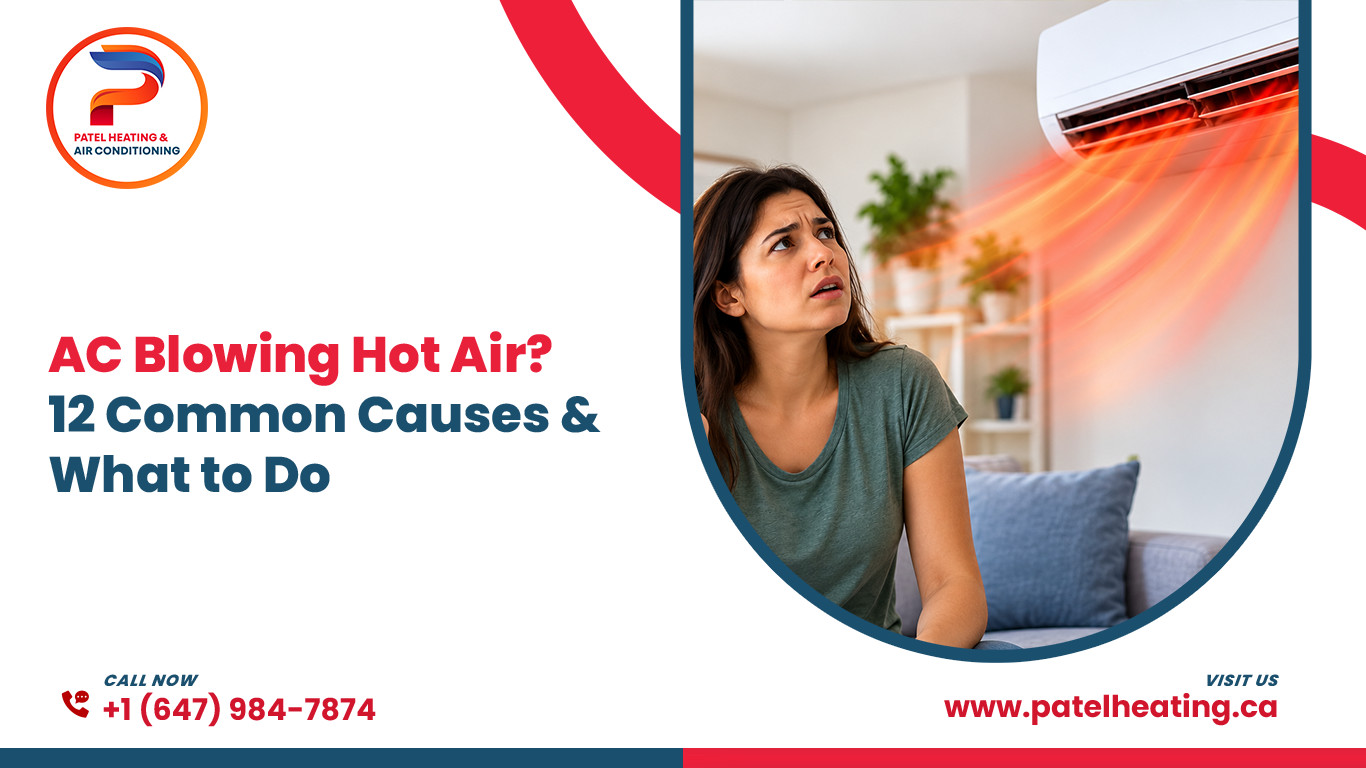
Is your air conditioner blowing hot air instead of cold air? Nothing is more frustrating than turning on your AC during a hot summer day only to feel warm air coming from the vents.
An AC blowing hot air is more than just an uncomfortable problem. It can be a warning sign that something inside your air conditioning system isn’t working properly. The issue could be as simple as an incorrect thermostat setting or a dirty air filter—or it could involve a refrigerant leak, electrical problem, frozen evaporator coil, compressor failure, or another major component.
The good news is that identifying the cause early can help prevent more expensive damage and restore comfort to your home faster.
At Patel Heating & Air Conditioning, we help homeowners with air conditioning problems throughout Mississauga and surrounding GTA communities. Here’s what you should know if your AC is running but isn’t cooling your home.
Why Is My AC Blowing Hot Air?
There are several reasons an air conditioner may run but blow warm or hot air. Some problems are easy to check yourself, while others require professional HVAC diagnosis and repair.
Here are 12 common reasons your AC may be blowing hot air.
1. Your Thermostat Is Set Incorrectly
Before assuming your air conditioner has a major problem, check your thermostat.
Make sure:
- ● The system is set to COOL
- ● The temperature is set lower than the current indoor temperature
- ● The fan setting is appropriate
- ● The thermostat batteries are working
If your thermostat is accidentally set to HEAT or the fan is operating incorrectly, your AC may not provide the cooling you expect.
If changing the settings doesn’t solve the problem, the thermostat itself could need service or replacement.
2. A Tripped Circuit Breaker or Electrical Problem
Your indoor AC system and outdoor condenser depend on electrical power to operate correctly.
Sometimes the indoor blower may continue running while the outdoor unit isn’t operating because of a tripped breaker or electrical issue. When that happens, air can continue circulating through your home without being properly cooled.
Check your electrical panel for a tripped HVAC breaker.
Important: If the breaker repeatedly trips, don’t keep resetting it. Repeated electrical problems should be inspected by a qualified HVAC professional.
3. A Clogged Condensate Drain Line
Air conditioning systems naturally produce condensation while removing humidity from indoor air. That moisture normally leaves through a condensate drain line.
Over time, algae, dirt, debris, or other buildup can clog the drain.
A blocked condensate line may cause:
- ● Water leaks
- ● Moisture buildup
- ● AC shutdowns
- ● Poor cooling performance
- ● Potential water damage
If you notice water around your indoor unit along with poor cooling, professional inspection may be necessary.
4. Dirty or Clogged Air Filters
A dirty air filter is one of the most common causes of HVAC performance problems.
When an air filter becomes clogged with dust and debris, it restricts airflow. Your AC then has to work harder to circulate air throughout your home.
Restricted airflow can contribute to:
- ● Reduced cooling
- ● Higher energy use
- ● Frozen evaporator coils
- ● Increased strain on the blower and other components
- ● Poor indoor comfort
Check your filter regularly and replace it when necessary according to the filter manufacturer’s recommendations and your home’s conditions.
Tip: Homes with pets, allergies, renovations, or high dust levels may require more frequent filter attention.
5. Dirty Evaporator Coils
Your evaporator coil plays an important role in the cooling process. It absorbs heat from the indoor air so your AC can deliver cooler air throughout your home.
When dirt and debris accumulate on the evaporator coil, heat transfer can become less effective.
The result can be weak airflow, reduced cooling, longer run times, and warm air coming from your vents.
Regular professional AC maintenance can help identify coil contamination before it develops into a bigger problem.
6. Frozen Evaporator Coils
If you look at your indoor AC system and see ice or frost around the evaporator coil or refrigerant lines, your system may have a problem.
A frozen evaporator coil can be associated with issues such as:
- ● Restricted airflow
- ● Dirty filters
- ● Low refrigerant
- ● Mechanical problems
Although it may seem logical to simply remove the ice, the ice is usually a symptom rather than the root cause.
If your AC coil is frozen, turn the system off and allow it to thaw, then have the underlying issue diagnosed by an HVAC professional.
7. The Outdoor AC Unit Has Lost Power
Your indoor and outdoor AC components work together.
The indoor blower moves air through your home, while the outdoor condenser rejects heat from the refrigerant system.
If the outdoor unit isn’t receiving power, your indoor blower may continue pushing air through the vents—but the air may not be cooled.
If the outdoor condenser isn’t running, check for obvious power issues. If you aren’t comfortable working around electrical equipment, contact a professional.
8. Low Refrigerant or a Refrigerant Leak
Refrigerant is essential to the cooling process.
If your system has low refrigerant, it may struggle to absorb and transfer heat effectively. Low refrigerant can sometimes be caused by a leak or another system problem.
Possible signs include:
- ● AC blowing warm air
- ● Longer cooling cycles
- ● Reduced cooling performance
- ● Ice on refrigerant lines or the evaporator coil
- ● Higher energy consumption
Refrigerant issues require professional diagnosis. Simply adding refrigerant without identifying the cause may not solve the underlying problem.
9. Leaking or Damaged Air Ducts
Your ductwork is the pathway that carries conditioned air throughout your home.
If ducts are leaking, disconnected, damaged, or poorly sealed, some of the cooled air can escape before reaching your living spaces.
This can lead to:
- ● Uneven temperatures
- ● Weak airflow
- ● Higher energy bills
- ● Rooms that stay warm
- ● An AC system that seems to run constantly
Professional duct inspection can help determine whether air leakage is contributing to your cooling problem.
10. Compressor Problems
The compressor is one of the most important components of an air conditioning system.
It circulates and compresses refrigerant as part of the cooling cycle. If the compressor isn’t operating properly, your AC may struggle to cool the air.
Compressor problems can be related to electrical issues, overheating, refrigerant problems, mechanical wear, or other system faults.
Because compressor repairs can be complex and expensive, professional diagnosis is important before deciding whether repair or replacement makes more financial sense.
11. A Broken or Failing Condenser Fan
The outdoor condenser fan helps move heat away from the refrigerant system.
If the fan isn’t working correctly, your AC may overheat and lose cooling performance.
You may notice:
- ● The outdoor fan isn’t spinning
- ● The fan is running unusually slowly
- ● Unusual noises
- ● Visible debris around the outdoor unit
- ● The AC shuts down repeatedly
- ● Warm air coming from indoor vents
Never put your hands near a running outdoor condenser fan. If you suspect a fan problem, have an HVAC technician inspect the system.
12. Blocked or Closed Return Vents
Return vents are an important part of your home’s HVAC airflow system.
Furniture, rugs, curtains, boxes, or other objects can accidentally block return vents. When airflow becomes restricted, your AC may have difficulty circulating conditioned air efficiently.
Make sure return vents and supply vents aren’t blocked by furniture or household objects.
If airflow remains poor after clearing the vents, there may be a deeper ductwork or HVAC problem.
What Should You Do If Your AC Is Blowing Hot Air?
If your AC is running but not cooling, don’t panic. Start with a few basic checks.
Step 1: Check the Thermostat
Confirm that your thermostat is set to COOL and that the temperature is set below the current room temperature.
Step 2: Check the Air Filter
If the filter is visibly dirty or clogged, replace it with the correct replacement filter.
Step 3: Check Your Electrical Panel
Look for an obvious tripped breaker associated with your HVAC system.
If it trips again after being reset, stop troubleshooting and contact a qualified professional.
Step 4: Check Your Vents
Make sure supply and return vents are open and aren’t blocked by furniture or other objects.
Step 5: Look for Ice or Water
Ice around the indoor unit or refrigerant line, or water around the AC system, can indicate a problem that needs professional attention.
Step 6: Know When to Call an HVAC Professional
If these basic checks don’t solve the problem—or if you suspect a refrigerant, electrical, compressor, or mechanical issue—it’s time to call an HVAC technician.
Should You Repair or Replace Your Air Conditioner?
Sometimes an AC problem can be repaired quickly. In other cases, replacing an older or inefficient system may be the better long-term choice.
An HVAC professional can evaluate factors such as:
- ● Age of your air conditioner
- ● Repair cost
- ● System efficiency
- ● Frequency of breakdowns
- ● Availability of replacement parts
- ● Overall condition of the equipment
- ● Expected future repair costs
Don’t automatically assume you need a new AC. A proper diagnosis can help you make an informed decision.
How to Prevent Your AC From Blowing Hot Air
Regular maintenance can help reduce the risk of unexpected cooling problems.
Consider these simple HVAC maintenance habits:
✅ Replace or clean air filters regularly
✅ Keep outdoor condenser areas clear of debris
✅ Keep indoor vents and returns unobstructed
✅ Schedule professional AC maintenance
✅ Pay attention to unusual noises or smells
✅ Don’t ignore weak airflow or poor cooling
✅ Address water leaks or ice buildup promptly
Preventive maintenance can help your system operate more efficiently and may catch developing problems before they become major repairs.
AC Blowing Hot Air? Patel Heating & Air Conditioning Can Help
When your air conditioner is blowing hot air, you don’t have to spend the day guessing what’s wrong.
At Patel Heating & Air Conditioning, we provide professional HVAC solutions for homeowners looking to restore reliable indoor comfort.
Whether your problem involves an air filter, airflow restriction, frozen coil, refrigerant issue, electrical component, condenser, compressor, or another AC component, a professional diagnosis can help determine the right solution.
Need AC Repair in Mississauga or the GTA?
📞 Call Patel Heating & Air Conditioning: +1 (647) 984-7874
📧 Email: patelheating@gmail.com
🌐 Website: www.patelheating.ca
Don’t let an AC blowing hot air ruin your summer comfort. Contact Patel Heating & Air Conditioning today for professional HVAC service.
Frequently Asked Questions About AC Blowing Hot Air
Why is my AC blowing hot air?
An AC can blow hot or warm air because of several problems, including an incorrect thermostat setting, dirty air filter, restricted airflow, frozen evaporator coil, electrical issue, outdoor unit problem, low refrigerant, leaking ductwork, compressor failure, or condenser fan problems.
Why is my AC running but not cooling?
If your AC is running but your home isn’t getting cooler, check the thermostat, air filter, vents, and electrical panel first.
If those aren’t the problem, the system may have a refrigerant, airflow, coil, condenser, compressor, or other mechanical issue that requires professional diagnosis.
Can a dirty air filter make my AC blow hot air?
Yes. A severely dirty air filter can restrict airflow and reduce the system’s ability to cool your home efficiently. It can also contribute to evaporator coil freezing and additional stress on HVAC components.
What should I do if my AC has ice on it?
Turn off the cooling system and allow the ice to thaw. Don’t attempt to chip the ice away with tools.
A frozen coil can have several underlying causes, including restricted airflow or refrigerant problems. If the problem returns, contact an HVAC professional.
Is it safe to keep running an AC that is blowing hot air?
It’s generally best not to keep operating an AC that isn’t cooling properly, particularly if you notice ice, water leaks, unusual electrical behavior, burning smells, or repeated breaker trips.
Turning the system off and arranging professional diagnosis can help prevent additional damage.
How often should I have my AC serviced?
Regular professional AC maintenance can help identify developing problems, maintain performance, and keep your cooling system operating efficiently. The ideal maintenance schedule depends on your equipment, usage, home conditions, and manufacturer’s recommendations.
When should I call an HVAC technician?
Call an HVAC professional if your AC continues blowing warm air after basic thermostat and filter checks, or if you notice refrigerant concerns, frozen coils, electrical problems, water leaks, unusual noises, poor airflow, or repeated system shutdowns.
Final Takeaway
An AC blowing hot air is a problem you shouldn’t ignore.
Sometimes the solution is simple—such as correcting the thermostat setting or replacing a dirty filter. But warm air can also indicate a more serious problem involving refrigerant, electrical components, airflow, the condenser, compressor, or other HVAC equipment.
If your AC is running but not cooling, getting the problem diagnosed early can help protect your equipment and restore comfort to your home.
Patel Heating & Air Conditioning
Professional HVAC Service for Mississauga & the GTA
📞 +1 (647) 984-7874
📧 patelheating@gmail.com
🌐 www.patelheating.ca
Stay cool. Stay comfortable. Trust Patel Heating & Air Conditioning.
Leave a Reply